Wednesday, September 8, 2010

Secrets of Hawaiian Healing Revealed in interview with - Kumu Dane Silva


By Linda Ballou


Kumu Dane Kaohelani Silva is a transcendent figure (pictured here)who synthesizes Western and Hawaiian healing modalities into one holistic toolbox. Kumu Silva learned the arts of lomi-lomi massage and the use of native plants for medicines from his elders on the Big Island of Hawai’i. He also studied chiropractic, acupuncture, biomedical stress point therapy, chi gong and tai chi. He gives lectures on the subject of integrated healing at the college level in Hawaii and California. He also provides formal training in the field of therapeutic massage and offers healing tours on the Big Island.

Born with a gift of healing he feels he bears the responsibility to help others. People come to him with serious disorder and it is his job to discern the root of the problem. This could be spiritual, physical, and emotional. Once the problem is identified he determines the proper modality to treat the patient

In my research for my article Healing Hawaiian Holiday I had the extreme pleasure of interviewing Kumu Silva on his home turf in Hilo.
He requested we meet at Coconut Island where we sat on a wall overlooking azure water ruffled by a cooling sea breeze.

LB: You say you come from power of the place. Can you expand on that for me?

KDS: Real estate people have a phrase location, location, location.
This may be the wisdom of their indigenous roots speaking. A place of healing is a special place. This Island, Coconut Island (Moku Ola) is a “place of refuge” where spiritual healing and other forms of healing took place. The ancients chose this place for a reason. It’s because this place has more mana. So we are looking for places with mana, or spiritual power to activate the healing process. If we chose a place that has no mana, then there is no assistance from nature. We are working against the flow.

LB: What things do you do to encourage this assistance from nature?

KDS: In a place like this no need to do much. The main thing is to not bring bad energy to the place. Of course, when people come to this place for healing their thoughts, energies, and their bodies are not in harmony with nature or other people. They begin a process of reorganizing and reordering their thoughts and their feelings.

LB: Sounds to me like what the Navajo people strive for the state of Hozho. Are you familiar? It is the state of being in harmony, with nature, family and society?

KDS: Don’t know enough about it to agree or disagree. There are too many elements that may be present for me to say. We see that indigenous Native Americans and indigenous Polynesians share many things. That is not a secret and that is always a wonderful discovery we make as we come together as cultures.

LB: Do you travel around talking to other native peoples?

KDS: Yes, I do and I encourage them to come here. I went to Canada twice last year to speak to First Nation Peoples.

LB: I am from Southeast Alaska where the Tlingit Indians are indigenous. I do see commonalities, especially the idea of being connected to the land. That brings me to your nature walks. What do you do when you take people on a healing tour?

KDS: Every body is different and we alter our program accordingly. In general, what we find is that people come to us with memories of pain, and feelings of separation and helplessness about the future. We take those memories and release them into the environment. We invite the ancestral spirits with prayers and chants and offer them gifts to absorb the pain.

LB: The environment can handle it?

KDS: Yes, the environment can handle it, and this is one of the environments right here that we come to. You go to the gas station you get fuel. You have to go to a place in nature that has the same resonance and attunement for your work. This is a place of healing.
Ancients discovered it so we can automatically come here and use it for the same purpose.

LB: Do you believe that the ancestors are here to assist in this healing process.

KDS: They are not sitting around waiting for you, but you can call them. Part of the ceremony and process are chants that invite the ancestors. Ancestors receive their gifts in exchange for guidance and their presence

LB: I understand that hula is a form of meditation to pull mana. Do you do hula? Do you do it in a prayerful way?

KDS: I was a student of hula when I was a younger man. But, I also practice Hawaiian martial arts and healing arts and the martial arts describe my lifetime and my career at this time. Hula and martial arts are all part of the same family. The dances we enjoy today with beautiful girls covered with flowers are all part of a tradition of sacred practices.


LB: In tai chi there are certain movements to manipulate the energy.
How is it different?

KDS: In tai chi there are three points of energy. One is called “ching” which is centered around the reproductive organs. The second type is called “chi” which is located near the heart that is concerned with food and air. Ching becomes chi. when you are able to take the chi and increase it in volume you create something else that is more refined. That’s called “shen” or spirit. When we talk about energy we need to know what kind of energy. The energy we put into our car? The energy we put into our body? The Chinese ancients came up with three distinct types of energy. Here in Hawaii we talk about healing energy, “Ola” or the life force. This island is called Moku Ola—Island of life and of healing of energy.

LB: I do meditations. I do feel very strong energy near the ocean. The Islands have always been a source of solace and sustenance for me. So, I think I kind of understand what you are saying, although I don’t know the prayers and refinement that you give.

KDS: Hawaiians talk about HA. The breath that correspond to chi. Same kind of concept—energy of the breath ... the air. Mana is a higher form of energy!

LB: A higher form, in that it is a more spiritual refined energy?

KDS: Yes. So here we have a spectrum of energy. It is like light—the difference between a stone and light.

LB: Between coarse and delicate? You receive this energy? Do you direct this energy to people through touch or just mentally?

KDS: Both! We use prayer to help us guide the energy and we use touch.
But, we don’t always have to touch. We want to have a close relationship with the environment. Is it possible to change the clouds? Is it possible to make it rain? Is it possible to make the waves go up or down? These are things that don’t involved touching, but they do involve manipulating energy to result in an outward change.

When we are working with a human touching them is a very easy way to transfer energy, but it does not change their lifestyle.

LB: You are the most well respected and recognized lomi-lomi massage master on the Big Island. Tell me more about how you use the “Loving Touch” when you are working with people

KDS: It is a privilege and a challenge. We are honored to be able to touch people when we work with them in their goals. But, it also involves a large responsibility to educate the patient and guide them towards a healing lifestyle.

LB: You have workshops in Puna? What kinds of things do you do? What should people approach you for? What do want people to know that you do for them?

KDS: The needs of people are very different. They are physical, mental, emotional and spiritual. We are skilled in multiple modalities. We have a lot of experience in caring for people. If we can’t find the ability in ourselves to cure the patient we refer them to someone else

LB: You council the person and then send them the appropriate expert?

KDS: My martial arts master told me he had brain tumor. He asked was there anything I could offer him. I asked, “Have you seen anybody.”
Yes, I have seen everybody—chiropractor, acupuncturist, massage, medical doctors and healers,” he said.

He came to my class. I had the students help me lomi-lomi him. He fell asleep. When he woke up he could speak clearly, he could walk, he could see. These three things were impaired when he introduced himself. So, he said to me “I feel good. What do you recommend?” I said, call the doctor get some surgery and remove the tumor from your brain! He said, “Why do that when I can just come to you?” You’d be coming to me for the rest of your life. You have a tumor in your brain. Get it out! He went he got it out. He is good to go now. I work with doctors, other healers, all different cultures to identify the specific need for this person. We are healers. We look for the specific modality to employ to address the person’s specific needs. Lomi-lomi is a multiple modality. In the western view it is massage and body work. In the Hawaiian and Polynesian view it is holistic.


LB: Ten years ago, I was honored to receive lomi-lomi from Margaret Machado's niece. The thing that struck me, aside from the fact that it was deeply emotional experience, was that she started with a Christian blessing. The incorporation with Christianity with the traditional Hawaiian massage kind of threw me. My question to you is how much are you influenced by Christianity? Do you incorporate the Christian blessing in your healing?

KDS: I don’t think so. I don’t intentionally invoke Jesus in my work. I am trained as a Hawaiian kahuna and prefer to respect my ancestors through prayers and rituals. There are many Christians who combine Hawaiian kahuna methods in their traditional healing work.

LB: There are those people who blend the cultures?

KDS: Yes, many of them.

LB: So, are you a purist?

KDS: I think traditionalist is more appropriate.

LB: You are a chiropractor-No?

KDS: Yes, retired.

LB: Did you study on the mainland?

KDS: Both. Lomi-lomi has been around way longer than chiropractors.
Lomi-lomi technique includes bone-setting.

LB: I read that the ancients lomied-lomied the fingers of infants to make the tapered antennas for mana. Also, the forehead was slanted back for a regal profile?
Is that true?

KDS: When I was young my grandmother massaged my forehead. I do it with children as well.

LB: What is the purpose of this?

KDS: Because people, like myself, when they are growing, part of our skull grows very fast. It is to accommodate the growth of our brain.
Also it is to beautify the person.

This type of massage is different than the type used in healing. For example when my son was born my wife asked me to lomi him to increase the flexibility of his joints. So, other mommies have come to me for that as well. Working with children to make them more flexible is one of the goals. If you have someone who comes from a family where they might have some spinal issues the children will be massaged as a treatment to discourage those problems.

LB Do you use the pebble outline of a person’s body that I’ve read about to divine the source of the problem?

KDS: Those pebbles are used to teach people. Different colored stones pertain to bones, organs, lomi points, etc. Yes, i love to use stones.
Today we have more tools than just stones. We have books, internet, anatomical models, videos, everything.

LB: Do you use the native plants in your healings?

KDS: Yes. These medicines can help save lives, and save limbs.

LB: Do you use the universal remedy the sea-water cleanse offered at Margaret Maschedo’s retreat?

KDS: I work with people with diabetes, cancer, all kinds of problems.
There are many types of cleansing. Sea water is the simplest, cheapest, fastest, but it does not clean out the liver, it cleans out the colon. If you have someone who needs to clean out their liver, or their pancreas, or their kidneys sea water would probably not be the best for them. I have a group of students right now who started from day one with blocked colons; by day 3 none of them were constipated.
Teach them how to mix the salt water, massage their tummies and give them physical movements to do every day. It is a holistic approach.

In western understanding health care comes from the chiropractor, the doctors, the pharmacist, but in cultures like ours one person does many things and they employ many different modalities. The use of salt water is like brushing your teeth it is not a big deal. Ten days is just the beginning. Repeat it several times each year. Make it part of your lifestyle. That means when you go to the baby luau you have one serving.

Sea Water has 3.5 grams of salt…we dilute it so that it is about 1 gram of salt. You make it to the salinity of blood. Blood is .9 grams of salt. Sea water is alkaline ph 8. Our blood is ph 7.35. We get sick when our blood gets to acidic. Too much acid in your body causes weakness and pain. Cancer is inflammation. Inflammation causes mutations in the cell. This creates bad things—waste products, pain and disease

LB: You are very slender are you vegetarian?

KDS: No. I am “traditionalistarian." Eat simple, traditional meals.
You can have a taste of everything, just don’t eat too much!

LB: Do you do your therapy in the Ahalanui Hot Ponds in Puna?

KDS: Yes, I worked on three people there yesterday. There are natural places for healing located in power spots that are effective.


LB: What does “Huna”- the secret – mean to you?


KDS: Don’t think of the word Huna. Think of word kahuna. Huna is a collection of secrets thoughts and practices handed down by the kahuna. A kahuna is someone who is capable of doing things that other people cannot. I was raised that there was to be no babbling of secrets. The ancients could not find someone of sufficient character to be worthy of their secrets.

LB: What happened to the secrets?

KDS: They took them with them to the other side. Through meditation, prayer and rituals, we are able to receive their guidance and support.

LB: Thank you Kumu Dane Silva

If you would like to learn more about Kumu Dane Silva’s workshops and retreats go to:
Hawaiian Healing Center or Email: kumulomi@gmail.com

Web-site: http://www.haleola.com/


***********
I walk in beauty of the good red road
Linda Ballou


http://www.lindaballouauthor.com/

Friday, September 3, 2010

September is Aloha Festival Month


In honor of September being The Aloha Festival Month in Hawaii and the surrounding islands, I have made September the Aloha Month here at this blog. My first novel, Wai-nani, High Chiefess of Hawaii, Her Epic Journey was the story of all that is the Hawaiian Culture. Wai-nani is a celebration of the Hawaiian people of old, especially the powerful Ka’ahumanu – forerunner to the modern woman.
Aloha Festivals is Hawai'i’s premier cultural showcase, a celebration of Hawai'i’s music, dance and history intended to preserve the unique island traditions.


The mission of Aloha Festivals is “to foster the Aloha Spirit through the perpetuation of the Hawaiian culture and the celebration of the diverse customs and traditions of Hawai'i”. Aloha Festivals was first held in 1946 as Aloha Week. It has become a celebration of our Hawaiian Culture integrated with the traditions and cultures of each of the islands through music, dance, cuisine and art. Each year, hundreds of volunteers labor to stage the events, which are enjoyed by nearly one million people.

For a look at the festival click here at Aloha Festivals.

During this month we will be featuring everything Hawaiian;

My interview – Secrets of Hawaiian Healing Revealed with Kumu Dane Silva - a transcendent figure who synthesizes Western and Hawaiian healing modalities into one holistic toolbox.

Article - Healing Hawaiian Holiday

My Book Interview at One Writer’s Journey

Ariticle - Lei of Light

Review - Wai-nani, High Chiefess of Hawaii

Article – Molokai


Enjoy!


I walk in beauty on the good red road.

Linda Ballou

http://www.lindaballouauthor.com/

Tuesday, August 31, 2010

Lost Angel Walkabout Now In Kindle Version


Lost Angel Walkabout, the perfect travel companion, is now available on Amazon’s Kindle. This eclectic collection of 28 travel essays is filled with thrills, spills, giggles and squeaks. Adventure travel writer, Linda Ballou, takes you river rafting in Alaska, trekking in New Zealand, kayaking in the Sea of Cortez, sailing around the Napali Coast and horseback riding in the wild west of America. Have fun with Linda, while getting to your own adventures, without tipping your canoe or straining one muscle.


I walk in beauty on the good red road.
Linda Ballou

http://www.lindaballouauthor.com/

Purchase at amazon;

Wai-nani, A new voice from Old Hawaii

Monday, August 23, 2010

A special thanks to Michael Shapiro for the following endorsement


Whether river rafting in the vast wilderness of her Alaska homeland or trekking through the emerald hills of New Zealand, Ballou's evocative writing takes you there. She reminds us that in a frenetic world connecting with nature's beauty can serve as our salvation.—Michael Shapiro, author of A Sense of Place


**
I walk in beauty on the good red road.
Linda Ballou

www.lindaballouauthor.com

The Best of the Best at the Travel Writing Conference


I was honored to have my picture taken with Don George, the master of ceremonies, of the Travel Writing Conference at the Book Passage and Tim Cahill who opened the festivities with a fun talk. Don has edited numerous travel essay anthologies for Lonely Planet and has a great website with tremendous information for travelers called Don’s Place.

His book Travel Writing published by Lonely Planet is the most comprehensive book on the subject, I have come across.

Tim Cahill has nine travel book under his belt and hundreds of articles, is nothing short of the master when it comes to adventure travel narrative. I had the pleasure of interviewing Tim in his home in Livingston, Montana among the many artifacts he has collected in three decades of adventure travel. You may read that interview in my book Lost Angel Walkabout-One Traveler’s Tales.

**
I walk in Beauty on the good red road.
Linda Ballou

www.lindaballouauthor.com

Stories from Tim Cahill at the Book Passage Travel Conference


Tim Cahill regaled the audience with stories at the Book Passage Travel Conference. Tim is America’s best known and funniest travel writer, founding editor of Outside Magazine and is the author of more than 7 books.

In his writing classes he teaches aspiring authors how to achieve “Flowbie.” This is a state of mind in which you are so totally engaged by your own imagination that you lose sense of time and place and awake a couple hours later with writing that you never knew you had in you.

Tim’s conversational style is always educational and is often laugh out loud funny. I had the pleasure of interviewing Tim in his home in Livingston, Montana among the many artifacts he has collected in three decades of adventure travel. You may read that interview in my book Lost Angel Walkabout-One Traveler’s Tales.


I walk in beauty on the good red road
Linda Ballou

www.lindaballouauthor.com


Friday, August 20, 2010

Lessons learned at the Book Passage Travel Writer's Conference


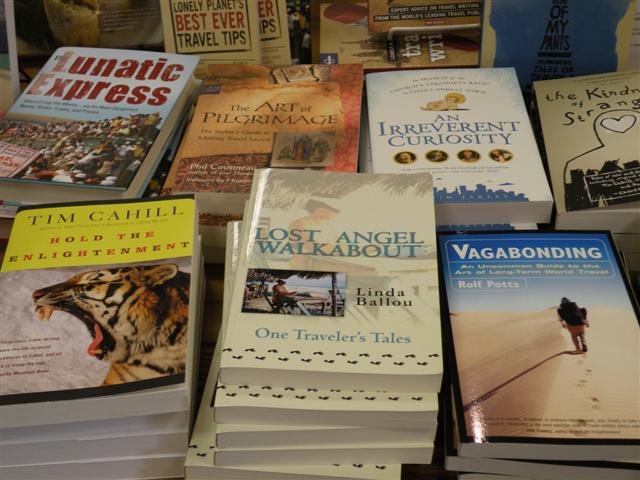
I was very proud to rub shoulders with the best travel essayists alive today. Lost Angel Walkabout-One Traveler’s Tales my second novel is nestled between Tim Cahill’s, Hold the Enlightenment and Rolf Potts, Vagabonding on center stage at the Book Passage Travel Writers Conference. While I came to share my work with others, I did not expect to receive encouragement and inspiration to carry forward. Phil Cousineau, an author I was not familiar with before I arrived, gave a talk about Stoking the Creative Fires. I didn’t realize it, but since the publication of my second book in May, Lost Angel Walkabout; One Traveler's Tales, I have been suffering from post partum. After listening to this brilliant, accomplished individual who has thought deeply about the subject of “Why Bother” to create, I felt not only justified but eager to get on to my next book!


Cousineau’s theme that art for “beauties sake” is worthwhile in our lives reminded me of John O’Donohue’s wonderful book The Invisible Embrace of Beauty. O’Donohue’s words re-enforced my own strong belief that “the secret to youth is to fill your mind with beauty.” Not that you will look any younger, but that your spirit will be replenished and freshened when your life is filled with beauty—be it a song, a book, a landscape or the smile of a child. I felt overwhelmed by a sense of serendipitous synchronicity when Cousineau revealed that he was a close friend of O’Donohue. I was saddened to learn that this thought-provoking man had died a year earlier at the age of 53. Perhaps, his work was done. I left the conference feeling mine had just begun.


I walk in Beauty on the good red road.
Linda Ballou

www.lindaballouauthor.com


Friday, August 13, 2010

The Land That Time Almost Forgot - Sea Kayaking Adventures Day 3


Sea Kayaking Adventures

by Linda Ballou, special to Baja Magazine

Day Three

Early the next day, we headed out from Punta Baja. Just as we crested the point, we saw a blue-footed booby and a pod of about thirty dolphins. The dolphins churned past us in a steady rhythm, making a beeline up the channel. After a brisk paddle into the wind, we were gliding on shallow turquoise water again, so clear I could see to the white sand bottom.

The beach was composed of whited powdery sand, wrapped in white cliffs with fat, chalk-colored stalactites dripping from the ceiling of the sea caves. Standing on the cliffs were black cormorants with their wings spread in the sun to dry, looking like scarecrows. A deep blaze of aquamarine green, so intense it glowed like a laser beam, shot across the width of the passage.

A week of yoga before breakfast, several of hours of paddling prior to lunch, a siesta and then a swim, left me feeling amazingly fit. So when our group was challenged by another cluster of kayaks to a race across the idyllic glide to Honeymoon Cove, I was game. I poured on the steam, gave it all I had and applied all the technique I had learned that week.

Having arrived at the tranquil Honeymoon Cove, I climbed to the top of the red bluffs that sheltered it. I peered down into water so clear that from several stories up I could see schools of fish. From this perfect vantage, I let my imagination run wild wondering what treasure might have been left behind by pirates who had come to this part of the world looking for a sage harbor.

My trip sadly came to a close, but I was very happy that this unique land that time almost forgot is only a few short hours from home. "I'll be back," I promised myself.


**Author's note
If you enjoyed these Sea Kayaking Adventures be sure to purchase a copy of my book, Lost Angel Walkabout; One Traveler's Tales and join me on more journeys as I explore Glacier Bay, Alaska, Tahiti, New Zealand, Grand Tetons, Wyoming and so many more places around the world. www.lindaballouauthor.com

Tuesday, August 10, 2010

The Land Time Almost Forgot - SeaKayaking Adventures - Day Two


By Linda Ballou Special to Baja Magazine

Day 2

The second day, we slid into the opalescent water early in the morning to beat the afternoon winds and were welcomed by a comfortable eighty degrees with a teasing breeze and rocking swells; it was a perfect paddle day. The deep water crossing from Danzante to Carmen Island is a wide stretch of open water that can present a challenge. Fernando, our local guide from La Paz, was paddling in perfect rhythm in the cockpit behind me, so I enjoyed a great sense of security.

The cliffs on the backside of Danzante display red sandblasted arches carved by ferocious Chubasco winds. Fernando pointed to a window in the rocks several stores up that navigators use to get their bearings. There are no beaches or trails on this side of the island, so kayaking is the ideal way to explore. We slipped up close to the cliffs to get a closer look at the sea caves. It was there I spied the nest of an osprey.

On the water, the natural flotsam consists of moss algae, sponges and the occasional jelly fish - the size of a dinner plate. We glided over boulders populated by magenta starfish and spiny purple urchins. Because there is no engine noise in a kayak, the wildlife doesn't scatter upon your approach. It allows you the sensation of being part of this translucent water world while remaining safe from the dangers of the deep.

The Sea of Cortez is the youngest sea on earth, a mere 25 million years old. It is cradled by rugged lava-rock cliffs that are embedded with numerous sea caves. Earthquakes generated from the San Andreas Fault created deep water canyons and separated the peninsula from the mainland. Strong ocean currents continually mix and lift food and nutrients from the deep ocean canyons, making this the perfect feeding ground for all types of marine mammals.

We quickly made the crossing to Punta Baja, where gulls greeted us with what sounded like hysterical laughter. A troop of pelicans flew close to the water in a "V" shaped wedge, webbed feet lowered for a splash landing. A lone, great blue heron held his station on the point, undisturbed by our arrival. The littoral was thick with shells, big corkscrew spikes, small orange cones and bivalves of every description. The shells in the fossil bed at Punta Baja are said to be as old as the sea itself.

Just as quickly as the ball drops on New Year's Eve at Time Square, the sun slid behind the windblown mountains, leaving a chill in the air. While others chose to sleep under the star speckled skies, I unraveled my tent poles and set up house. When I unzipped my bedroom at sunrise I was greeted with the sight of soft, muted mauves and purples draping over the Isla Montserrat. I watched the sun lift its warm face over the shimmering mirrored surface, turning the sky to an opalescent pink. In the distance, dolphins did somersaults.

It was time for breakfast; eggs with cactus, tomatoes and guacamole. We were a tribe now, accustomed to each other's morning face. We were becoming deeply immersed in the peaceful and unhurried rhythms of Baja. At Arroyo Roja, we enjoyed a view of lava cliffs. A row of rock fingerlets, where Sally Light-foot crabs scuttled at my approach, made for fun tide-pooling. Underwater, I spied on Sergeant Majors, parrot fish, stickfish, and Rainbow Wrasse as they flitted in and out of the oatmeal-colored algae. I floated over boulders peppered with starfish and anemones. I felt light years removed from my ever-present thoughts of danger and worries and from the question that eternally plagued me, "what's for dinner?"


Read more here


or check back with us on Thursday, August 12, for the adventure of Day 3
Linda is the author of Wai-nani, The High Chiefess of Hawaii - Her Epic Journey, and Lost Angel Walkabout: One Traveler's Tales. Find both these books at her website, www.lindaballouauthor.com

Wednesday, August 4, 2010

The Land Time Almost Forgot – Sea Kayaking Adventures - Day One


By Linda Ballou - Special to Baja Life Magazine Spring 2001

I am certain that the sights that surround me are much the same as those experienced by John Steinbeck and his crew of naturalists when he explored the region in 1941. As I recall their early adventures, our head guide Jackie, brings me back to reality as she tells us that we are about to be introduced to muscles we never knew we had. Our group of twelve, all in varying degrees of physical fitness, receives instructions to push, not pull the paddle, so as not to become overtired. We are to use a flat palm, and a loose thumb on the paddle, ore else suffer from tendonitis.
As I donned my life vest, I began to fear that I might have made a terrible mistake. Much like the pelicans I had been watching just moments before, I too was an awkward disaster just waiting to happen. I prayed that like them, I would acquire grace once in action. I remembered the outfitter's literature, promising that by merely practicing a few exercises prior to the trip, any reasonably fit person could enjoy the thrill of gliding over serene waters in a sea kayak. None-the-less, my stomach churned as I contemplated the fact that within moments, nothing but a thin shell of fiberglass would separate me from the deep blue waters of the Sea of Cortez.

Before I could further consider my fears, we were off. At three miles an hour, it would take us an hour to reach our first stop at Danzante Island. I soon found myself enjoying a unique sense of freedom. There I sat, balanced neatly on the bow, watching as swarming shoals of fish darted below and pelicans scooped dinner into their fleshy pouches. I felt like a dolphin riding the crest of the waves - finally fearless! . . . .

By the time we stopped for lunch, I was thrilled at being in this vast ocean wilderness. As we cruised across the waters, the brilliant sun beat down upon us. I was eager to escape the heat and experience the underwater world of marine life. Clad in snorkel gear and fins, I prepared to enter the waters Steinbeck had dubbed, "ferocious with life." Biologically the richest body of water on the planet, the Sea of Cortez supports over 900 species of marine vertebrates and over 2,000 invertebrates. As I slipped into the transparent waters that lure outdoor adventurers from around the globe, all that was visible was the rust color of the cliffs surrounding our beach camp and a few darting electric blue fish. The sea shelf dropped off abruptly to depths where there is no visibility, so I headed back to my group and the lunch that awaited me. Just moments after leaving the water, a fin whale the size of a city bus emerged, arching its great girth. Stunned that I had been just feet away from this behemoth creature that swills krill by the ton, and has a heart the size of a Volkswagen, I realized I needed to be more alert during my explorations!


read more here


Stay tuned for more of Linda's adventures on Day 2 in the The Land That Time Almost Forgot.